
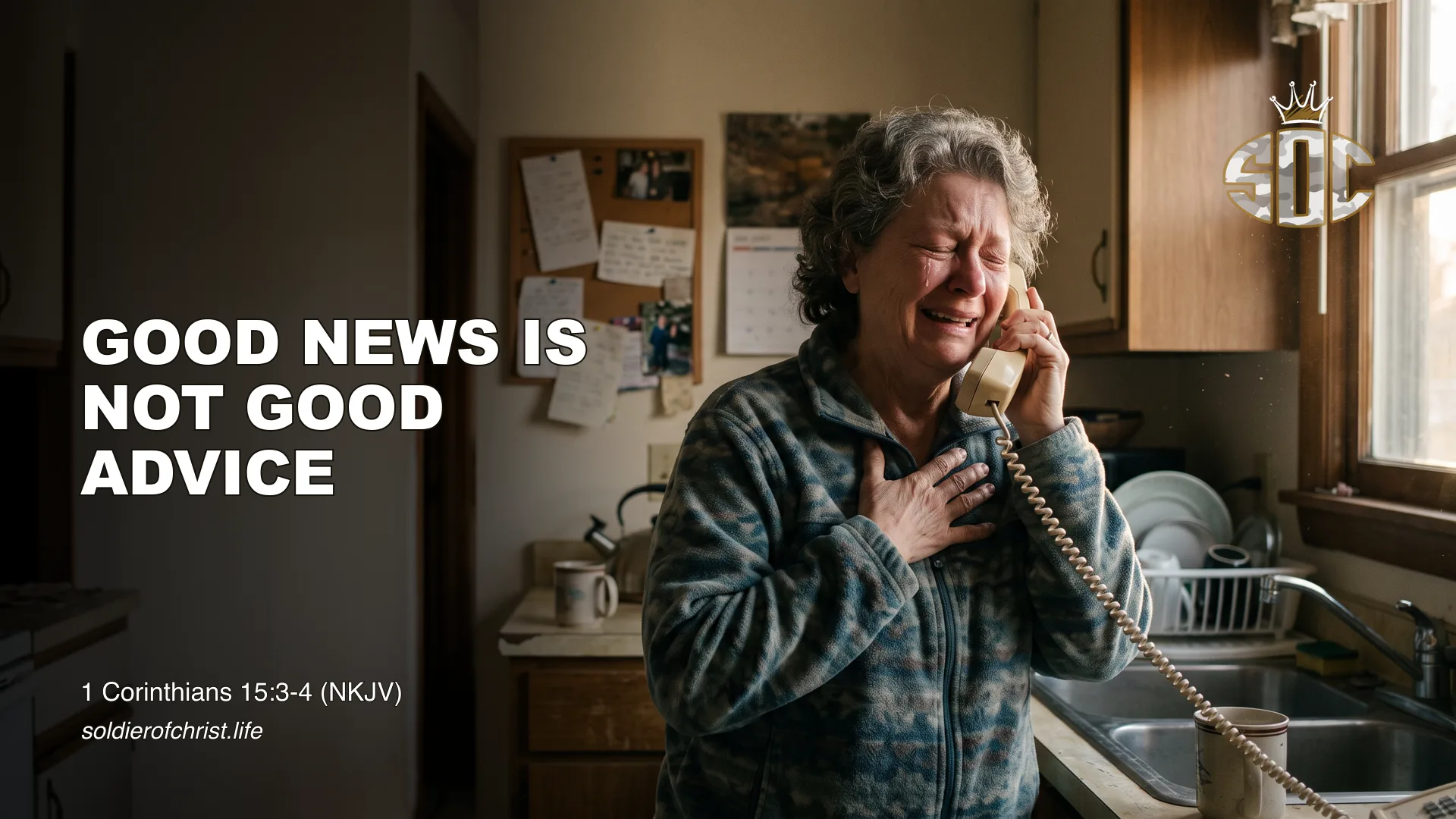
There is a particular phone call that changes the temperature of a whole family.
Somebody has been prayed for so long that the praying had gone quiet, turned into a habit, a name said at the end of a list. Years of it. And then the phone rings on an ordinary Tuesday and the voice on the other end is different. Not fixed. Not finished. Different.
In most families somebody knows exactly which name that would be. You have carried them so long that you have stopped expecting the call, and you would still take it at three in the morning without asking who it was.
That call is what the word gospel actually means. Not a doctrine. News. Something that happened, that somebody has to go and tell.
Good news is not good advice
We have made the gospel into advice so often that people can no longer hear the difference.
Advice tells you what to do. Try harder, pray more, come back when you have sorted yourself out. It puts the weight on you and calls that encouragement. And it is exhausting, because there is always more you could have done.
News is different. News tells you what has already happened, whether or not you were ready for it. Paul uses the plainest possible words in 1 Corinthians 15:3-4: Christ died for our sins, He was buried, He rose again. Those are events. They do not wait for your improvement, and they do not become less true on a bad week.
That is the difference between religion and rescue. One hands you a programme. The other tells you somebody already came for you.
Why the news lands on the person, not the argument
Notice what actually changes people in Scripture. Rarely a better argument. Usually a person who has been reached, standing in front of somebody who has not.
The man in Mark 5, freed from what had ruled him, asks to follow Jesus and is sent home instead, to tell his own people what had been done for him. The woman in John 4 leaves a water jar behind and goes back to the town that knew exactly who she was. Neither of them was trained. Both of them had news.
I wrote a poem about that phone call for the September pages of the devotional. It opens where the feeling actually starts:
I hear nothing but good news, My brother is saved now, and he knows the truth.I honor your decision to become a troop. · NKJV
That is the sound of somebody hearing it, not explaining it. Joy first, understanding afterwards. That is the right order, and most of us get it backwards.
The rest of the poem is in Where God's Love Found Me, the Agape-7 devotional, one for every day of the year.
What makes it hard to say out loud
If the news is this good, why is it so difficult to tell anybody?
Usually not because we doubt it. Because we are aware of ourselves. We know our own week. We know the gap between what we say we believe and how we spoke to somebody on Thursday, and we assume that gap disqualifies us from opening our mouths.
It does not. The messenger has never been the message. Nobody hearing about a rescue asks whether the person telling them deserved to be rescued first.
There is a second reason, quieter. Telling somebody costs you something. It risks the friendship, the family dinner, the way you are seen at work. That cost is real, and pretending otherwise is why so much evangelism advice sounds like it was written by somebody who has never been embarrassed.
Scripture does not pretend. Romans 1:16 says Paul is not ashamed of the gospel, which is only worth saying out loud in a world where shame is the obvious response.
Where to start, if you want to
Start with the one name you already carry. Not a strategy. A person.
Then say the true and small thing rather than the complete thing. Not a summary of the faith. What is actually happening in you: that you have been forgiven something, that you are less afraid than you used to be, that there is a reason you keep going back.
Then stay. Most people do not come to Christ during the conversation. They come months later, remembering that somebody stayed after being honest with them.
This is why the ministry works the way it does, in Kansas City and Springfield, Missouri as well as online. News travels through people who are near enough to be believed. And it is why it belongs in a family rather than in a private account: growing spiritually together is where you learn to say it out loud without flinching.
The call you are waiting for
Somebody reading this is on the other end of that phone call. You are the name on somebody's list, said quietly for years, and you have assumed the door closed a long time ago.
It did not. The news is not that you have improved. It is that Christ died and rose, and that the invitation is open on a day you did not earn.
You do not have to arrive fixed. Come as you are, and let the fixing be His work rather than your entry fee.
Start where you are. Begin the walk with Christ, find something solid to stand on in the resources, and let scripture-based verse speak life through Rhythm And Poetry.
Somebody is waiting to make that phone call about you.
Questions people ask
What does the word gospel actually mean?
It means good news: a report of something that has already happened. 1 Corinthians 15:3-4 states the events plainly, that Christ died for our sins, was buried and rose again.
What is the difference between good news and good advice?
Advice tells you what to do and puts the weight on you. News tells you what has already happened, whether or not you were ready for it. The gospel is the second kind.
How do I share my faith without being pushy?
Start with one person you already carry rather than a strategy. Say the true and small thing about what is happening in you rather than a summary of the whole faith. Then stay, because most people come later, remembering that somebody was honest and did not leave.
What if I feel unqualified to tell anyone?
The messenger has never been the message. Nobody hearing about a rescue asks whether the person telling them deserved to be rescued first.