
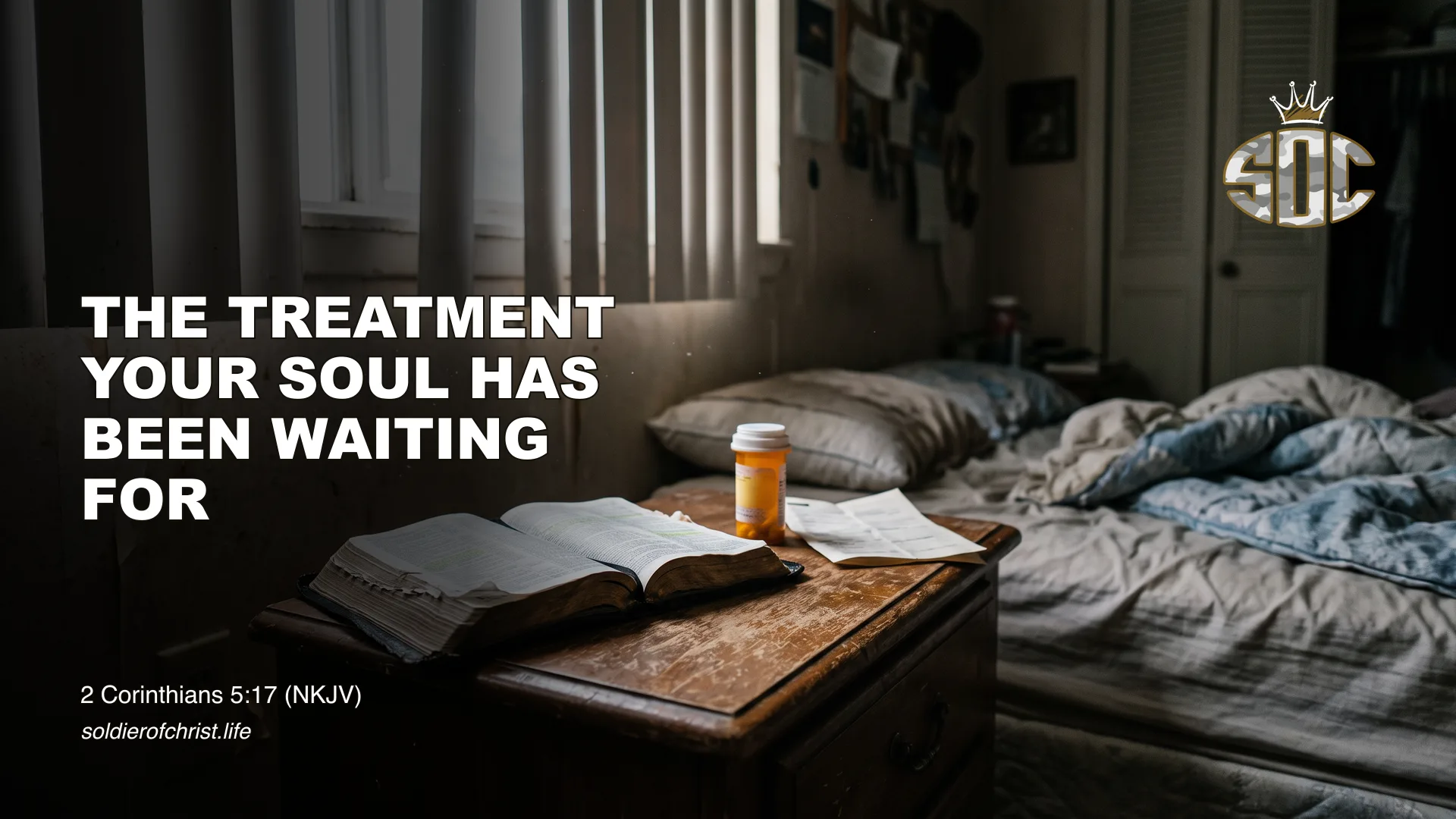
Somewhere in a clinic this week, someone will hear the word "treatment" in a way that changes everything. Not a pill for a headache. A plan. Weeks of it, maybe months. A binder of instructions to follow whether or not they feel like following them that day.
Somewhere else this same week, in a different kind of waiting room, a man in a recovery meeting will use the word differently. "I'm in treatment," he'll say, and the room will nod, because everyone there knows treatment is not one hard conversation and then it's over. It is a long, unglamorous return to the same chair, the same steps, until the thing breaking a life stops breaking it.
Both rooms understand something the rest of us forget: healing is rarely a single moment. It is a course of treatment, and that word is exactly the one Apostello Archegos reached for when he wrote about what God actually is to a person who is hurting.
Treatment Assumes You're Still Being Worked On
A cure implies the problem is over. A fix implies it was simple. Treatment assumes ongoing care, and that whoever is treating you is not going anywhere until you are.
That is the picture behind the poem this post is built on, from the Agape-7 devotional, Where God's Love Found Me:
Lord, You planted this in my heart with a seed;
A seed of faith and patience, engraved in me.
King, You are my treatment, a final key
To unlock my destiny and always be free.
Notice what the poem does not say. It does not say God handed over a plan and left the room. It says God is the treatment: not the doctor writing a prescription from behind a desk, but the one present for every dose, every setback, every appointment rescheduled because life happened again.
What Scripture Shows Us
The Bible does not describe God's care as a single transaction. Paul writes that "if anyone is in Christ, he is a new creation; old things have passed away; behold, all things have become new" (2 Corinthians 5:17, NKJV). That newness starts an ongoing relationship, an adoption still being raised in, not a finished transaction (Romans 8:15, NKJV).
The Psalms are blunt about who this treatment is for. It is "the brokenhearted" and those "of a contrite spirit" that the Lord is near to and saves (Psalm 34:18, NKJV). Not the person who has it together. The person still in the middle of the appointment.
And when honest accounting has to happen, Scripture is direct: "If we confess our sins, He is faithful and just to forgive us our sins and to cleanse us from all unrighteousness" (1 John 1:9, NKJV). Confess, and be cleansed. Show up again tomorrow.
Why "A Final Key" Matters More Than "A Fix"
The poem calls God "a final key to unlock my destiny." Not temporary, not one option among several. Final, meaning the search is over even while the treatment continues.
That distinction matters to anyone who has been through a real course of treatment. You do not get to skip the process, but you can know, partway through it, exactly who is treating you and where it ends. That is not always true in a clinic. It is true in Christ, who Paul says outfits believers with "the whole armor of God, that you may be able to stand against the wiles of the devil" (Ephesians 6:11, NKJV): protection for the fight ahead, not just relief from the one already fought.
How to Walk This Out
- Name what you are actually being treated for. Vague pain is hard to pray about. Specific pain, spoken plainly, is where honest prayer starts.
- Expect the process, not just the outcome. God builds faith in the waiting room, not just at the discharge papers.
- Keep the appointment on the hard days. Prayer, Scripture, and fellowship are the return visits. Skipping them breaks the course of treatment.
- Let the seed be a seed. Faith and patience were "engraved" like a seed, not delivered as a finished tree. Growth takes the time growth takes.
Prayer
Lord, You already know what I am being treated for, even the parts I have not said out loud. Thank You for being present in the process and not just at the finish line. Give me patience with the seed You planted, and faith to keep the appointment tomorrow. In Jesus' name, amen.
Continue the Journey
If this is a season where you need an actual next step, start here and see what walking with Christ looks like in practice. Soldier Of Christ has resources built for exactly this kind of ongoing season, and Rhythm And Poetry carries more Scripture-rooted work in the same voice. If you read this after Mercy Is New Every Morning, you already know this ministry believes healing is a daily, repeatable mercy.
FAQ
Is it wrong to see a doctor if I have faith in God? No. Scripture never asks believers to reject medical care as a test of faith. God works through doctors and medicine, as well as through direct healing. Treatment and trust are not opposites.
What does it mean that God is my "treatment" rather than my "cure"? A cure implies the story is finished. Treatment describes an ongoing relationship where care continues for as long as it is needed.
How do I stay patient when the healing feels slow? Bring the specific need to God honestly, keep showing up to prayer and Scripture, and let growth take the time it takes rather than measuring it against a deadline.
What if I mess up the treatment plan, spiritually speaking? First John 1:9 promises confession leads to forgiveness, not disqualification. A missed step is the next honest thing to bring back to God, not the end of the process.
Questions people ask
Is it wrong to see a doctor if I have faith in God?
No. Scripture never asks believers to reject medical care as a test of faith. God works through doctors and medicine, as well as through direct healing. Treatment and trust are not opposites.
What does it mean that God is my "treatment" rather than my "cure"?
A cure implies the story is finished. Treatment describes an ongoing relationship where care continues for as long as it is needed.
How do I stay patient when the healing feels slow?
Bring the specific need to God honestly, keep showing up to prayer and Scripture, and let growth take the time it takes rather than measuring it against a deadline.
What if I mess up the treatment plan, spiritually speaking?
First John 1:9 promises confession leads to forgiveness, not disqualification. A missed step is the next honest thing to bring back to God, not the end of the process.