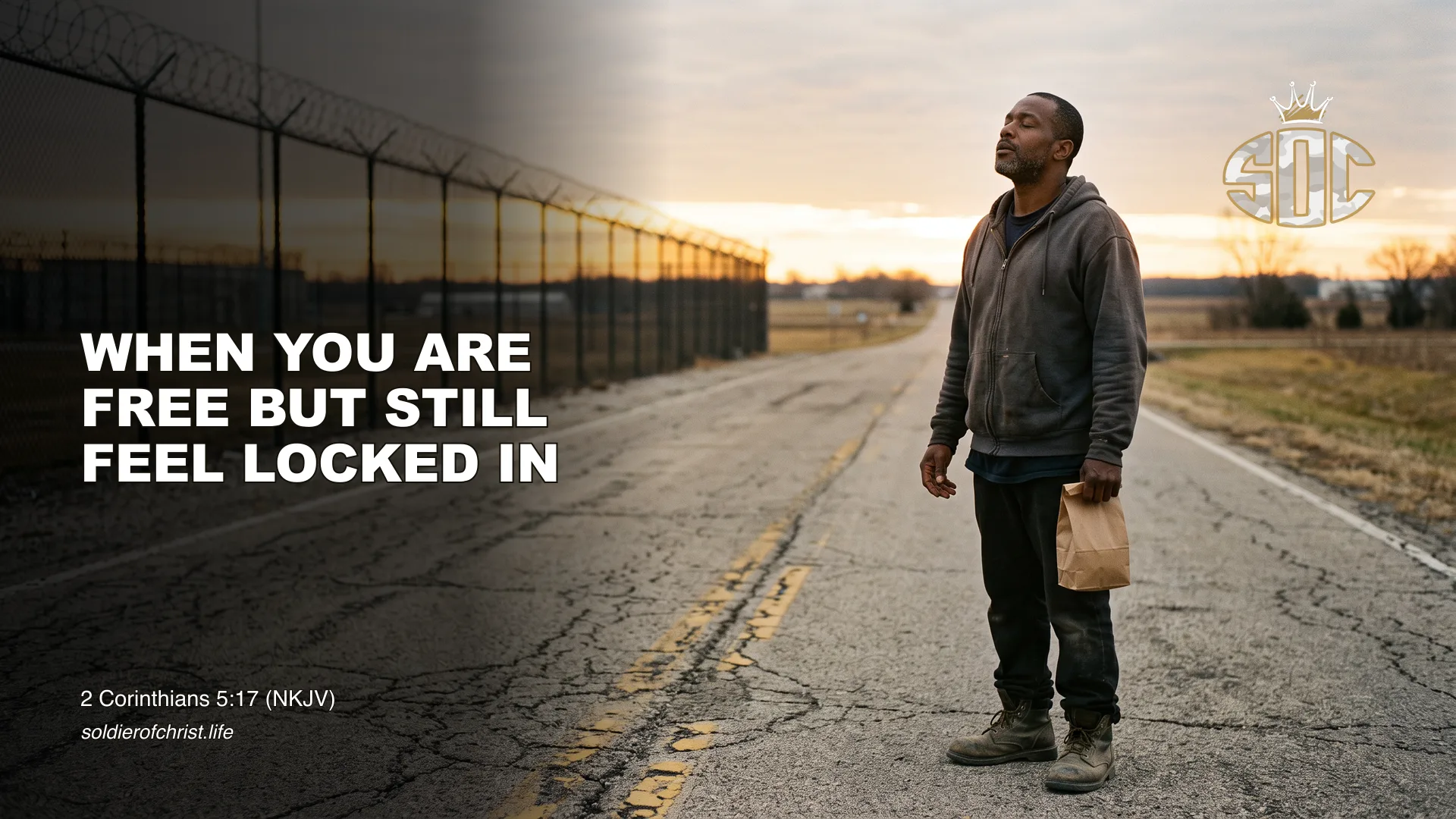
Somewhere in Missouri this week, a man will walk out through a gate he has looked at from the inside for years. He will carry everything he owns in a paper bag. The road in front of him will be empty and cold, and the sun will be coming up over a field he has only seen through wire. He will stand there longer than he needs to, because his body has not caught up with the paperwork. On paper, he is free. In his chest, the gate is still closing.
That moment is not only for people leaving a prison. It is for anyone who has been told "you are forgiven" and still wakes up every morning feeling locked in. The addiction is behind you, but the shame still counts the days. The old life is over, but you still flinch when someone says your name. You believe Jesus saves. You just cannot believe He has actually let you out.
Free on paper, bound in the heart
We picture freedom as a burden lifting, a clean break. So when the feeling does not come, we assume the freedom did not either.
But freedom in Christ is not a mood. It is a verdict. When Jesus told the crowds that the one the Son sets free is free indeed (John 8:36), He was not describing an emotion that comes and goes. He was announcing a legal fact about your life. The debt is paid. The record is closed. The door is open, whether or not your feelings have walked through it yet.
That is why the enemy works so hard on your feelings. He cannot lock the door again, so he tries to convince you it never opened.
What the poem says
The Agape-7 devotional, Where God's Love Found Me, has a poem for November 23 called "I Am Free." It opens like this:
I am finally free from being a slave,
No more bondage to sin, I put my old life in the grave.
Yeshua loosened my shackles and gave me strength to be saved;
Through His blood, His life, He made the way.
Notice who does the work in those lines. The one speaking is free, but he did not pick the lock. Yeshua loosened the shackles. His blood made the way. The only thing the speaker does is bury what is already dead.
That is the order of the Gospel. God moves first. We respond.
But God demonstrates His own love toward us, in that while we were still sinners, Christ died for us.Romans 5:8 · NKJV
He did not wait for you to feel clean before He paid for you. He paid while you were still in the cell.
The old life goes in the grave
Paul wrote to the church in Rome that believers have been set free from sin and have become servants of righteousness instead (Romans 6:18). Freedom in Scripture is never just freedom from something. It is freedom for Someone. You are not released to wander. You are released to belong.
Therefore, if anyone is in Christ, he is a new creation; old things have passed away; behold, all things have become new.2 Corinthians 5:17 · NKJV
"Old things have passed away" is past tense. The grave is already dug. Many of us keep visiting it anyway, reading the headstone, wondering if the old life will climb back out. It will not. Christ did not bury your past so you could keep it company.
If you have been carrying the weight of what you did, read Does God Still Want Me After What I've Done?. The answer is yes, and the reason is not you.
Why freedom can still feel like a cell
Paul also warned the Galatians to stand firm in the liberty Christ gave them and not to be tangled again in a yoke of bondage (Galatians 5:1). That warning only makes sense if it is possible to be free and still live like a prisoner.
It happens in small ways:
- You keep asking permission for grace you have already been given.
- You keep your guard up with God, as if He might change His mind.
- You measure your worth by your worst day instead of by the cross.
- You go back to the old place because the new one feels unfamiliar.
None of that undoes your freedom. It only means your heart is still learning the way out. The man at the gate does not become less released by standing still. He just needs someone to tell him he can start walking.
How to walk out the gate
Name it before God. Tell Him plainly what still has a hold on you. He is not surprised. Jesus invites the tired to come: "Come to Me, all you who labor and are heavy laden, and I will give you rest" (Matthew 11:28).
Say it out loud. The poem ends with a confession that Jesus is LORD. Scripture ties that confession to salvation itself:
that if you confess with your mouth the Lord Jesus and believe in your heart that God has raised Him from the dead, you will be saved.Romans 10:9 · NKJV
Stop walking alone. Freedom grows in community. Find believers who will remind you of the verdict when you forget it. Our Christian resources page is a good place to start.
Start again today. Not tomorrow, not once you feel ready. If you are wondering whether it is too late, read Can I Really Start Over, or Is It Too Late?.
The road in front of that man at the gate is still empty. But it is his to walk. Yours is too.
If this poem spoke to you, there are 365 more days of it in Where God's Love Found Me. Join the Agape-7 launch list, explore more scripture-based poetry on Rhythm And Poetry, or read how God met Apostello Archegos.
Discover true freedom in Christ Jesus. The gate is already open.
Questions people ask
What does it mean to be free in Christ?
It means the penalty of sin has been paid by Jesus on the cross and its power no longer owns you. Scripture describes believers as set free from sin to belong to God and live for righteousness (Romans 6:18). It is freedom from bondage and freedom for a relationship with Him.
Why do I still feel guilty after God has forgiven me?
Feelings often lag behind facts. Shame, old habits and the accuser all work on how you feel, because they cannot change what Christ has done. Bring the guilt to God honestly, confess what needs confessing, and let His Word, not your mood, tell you where you stand.
Can I go back to living in bondage after being set free?
You can live like a prisoner even with the door open. Paul warned the Galatians to stand firm in their liberty and not be tangled again in a yoke of bondage (Galatians 5:1). If you have drifted back, the way out is the same as the first time: turn to Jesus and walk with Him again.
Where does the poem "I Am Free" come from?
"I Am Free" is the November 23 poem in Where God's Love Found Me, Agape-7, the 365-day poetry devotional by Apostello Archegos, releasing July 3, 2027. This post quotes a short excerpt; the full poem is in the book.