
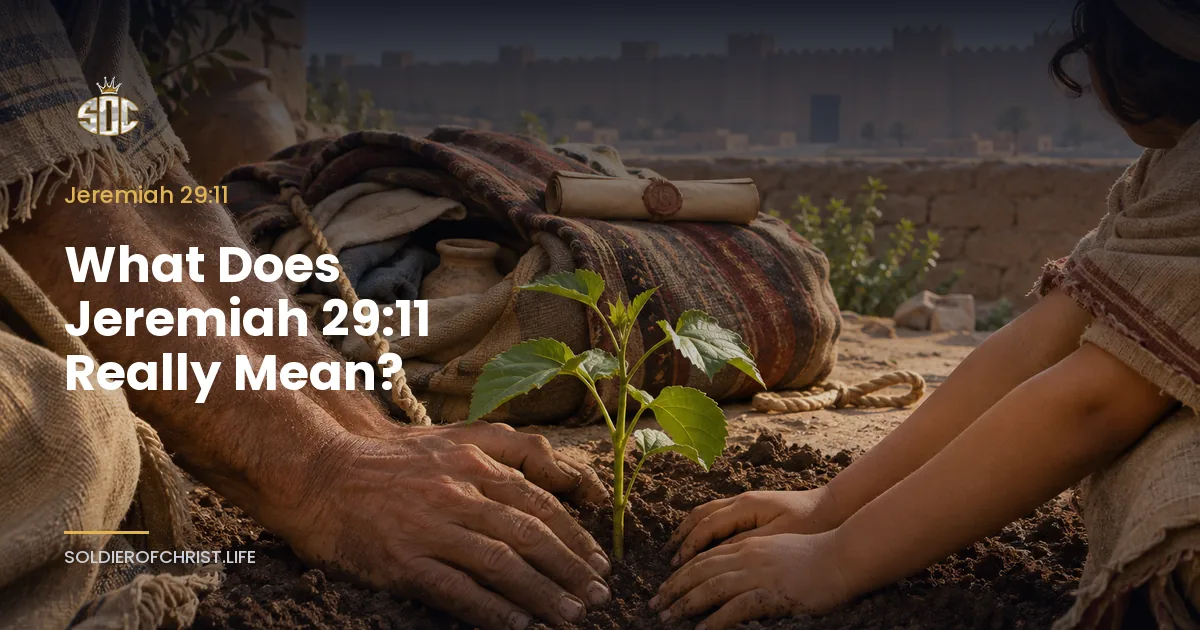
[HERO_URL]
The short answer. Jeremiah 29:11 was written in a letter to Israelites who had been carried away captive to Babylon. God says, "For I know the thoughts that I think toward you, says the LORD, thoughts of peace and not of evil, to give you a future and a hope." But the verse right before it says the return would come "after seventy years." So this is not a promise of quick rescue or guaranteed success. It is a promise that God had good intentions toward His people in the middle of a long, hard season, that He would be found when they sought Him with all their heart, and that He would bring them home. For us, that promise is kept in Jesus Christ, who is where every promise of God lands.
Key Takeaways
- Jeremiah 29:11 was written to a whole community of exiles in Babylon, not to one person about a career or a calendar.
- The verses before it tell them to build houses, plant gardens, and pray for the city they were held in. God told them to settle in.
- Verse 10 sets the timeline at seventy years. Many who first heard the letter would not live to see the return.
- A false prophet had promised rescue within two years. Jeremiah called that a lie. Jeremiah 29:11 is the true word, and it is slower.
- The verses after it matter most: "you will seek Me and find Me, when you search for Me with all your heart."
- Every promise of God finds its "Yes" in Jesus. The future and the hope have a name.
1. Read the envelope first
Most people meet Jeremiah 29:11 alone. On a card, a mug, a wall. But it was never alone. It sits in a letter, and Jeremiah 29:1 tells you who the letter was for: the elders, the priests, the prophets, and all the people Nebuchadnezzar had carried away captive from Jerusalem to Babylon.
Then God speaks to them directly:
Thus says the LORD of hosts, the God of Israel, to all who were carried away captive, whom I have caused to be carried away from Jerusalem to Babylon:Jeremiah 29:4 · NKJV
Notice two things. First, the "you" in this letter is a whole people, "all who were carried away captive." Second, God does not say Babylon happened to them by accident. He says, "whom I have caused to be carried away." This was a season of discipline, and they were in it.
So before Jeremiah 29:11 says anything about a future, it is spoken to people who had been torn from their homes, their city, and the house of the LORD. That is the room this verse was written into.
2. God told them to unpack
If you were in exile and got a letter from God, you would expect it to say, "Hold on, I am getting you out." Here is what it said:
Build houses and dwell in them; plant gardens and eat their fruit.Jeremiah 29:5 · NKJV
The next verse tells them to marry, have children, and see their families grow there. Then this:
And seek the peace of the city where I have caused you to be carried away captive, and pray to the LORD for it; for in its peace you will have peace.Jeremiah 29:7 · NKJV
Pray for Babylon. Seek the peace of the place that took you. That is not escape language. That is long-haul language. God was telling them, "You are going to be here a while. Live faithfully where you are."
Hold on to that word "peace." It comes back in verse 11.
3. Seventy years, and the prophet who said two
Here is the verse that most people never read:
For thus says the LORD: After seventy years are completed at Babylon, I will visit you and perform My good word toward you, and cause you to return to this place.Jeremiah 29:10 · NKJV
Seventy years. A lifetime. Many of the adults who first received this letter would not live to see the end of it. The ones who walked home would largely be their children and grandchildren.
And they had been offered a faster word. One chapter earlier, a prophet named Hananiah stood up and said:
Within two full years I will bring back to this place all the vessels of the LORD's house, that Nebuchadnezzar king of Babylon took away from this place and carried to Babylon.Jeremiah 28:3 · NKJV
Two years sounded better than seventy. It was also false. Jeremiah answered him:
"Hear now, Hananiah, the LORD has not sent you, but you make this people trust in a lie.Jeremiah 28:15 · NKJV
The letter in chapter 29 repeats the warning. "Do not let your prophets and your diviners who are in your midst deceive you" (Jeremiah 29:8), "For they prophesy falsely to you in My name; I have not sent them, says the LORD" (Jeremiah 29:9).
This is the part that changes how you read verse 11. In context, Jeremiah 29:11 is the opposite of a quick-fix promise. The quick fix was the lie. The true word was slower, and it was good.
4. "Thoughts of peace and not of evil"
Now the verse itself:
For I know the thoughts that I think toward you, says the LORD, thoughts of peace and not of evil, to give you a future and a hope.Jeremiah 29:11 · NKJV
Read it in its room and it gets heavier, not lighter.
God is saying to people in captivity: I know what I am thinking toward you. You may read this season as Me being done with you. I am not. My thoughts toward you are peace, not evil. The same word He used in verse 7, when He told them to seek the peace of Babylon, is the word He uses for His own heart toward them.
And He promises "a future and a hope." Not a shortcut. A future. The exile was real, but it was not the end of the story.
What the verse does not promise: that nothing will go wrong, that the hard season will be short, that every individual reader will see the outcome in this life, or that a specific plan for your job or your relationship is guaranteed. It never said those things to the exiles either.
What it does promise is better and harder: God's intentions toward His people are good even when their circumstances are not, and He is moving history toward their restoration.
5. Keep reading: the verses after it
Jeremiah 29:11 is not the end of the sentence God was building. Look at what comes next:
Then you will call upon Me and go and pray to Me, and I will listen to you.Jeremiah 29:12 · NKJV
And you will seek Me and find Me, when you search for Me with all your heart.Jeremiah 29:13 · NKJV
I will be found by you, says the LORD, and I will bring you back from your captivity; I will gather you from all the nations and from all the places where I have driven you, says the LORD, and I will bring you to the place from which I cause you to be carried away captive.Jeremiah 29:14 · NKJV
This is the center of the promise. The "future and a hope" is not mainly a better situation. It is God Himself. "You will seek Me and find Me." The return home came after that. The relationship came first.
So if you have been holding Jeremiah 29:11 like a guarantee about outcomes, here is the invitation in the next two verses: stop chasing the outcome and seek Him. With all your heart. He says He will be found.
6. So is Jeremiah 29:11 for me?
Fair question. It was written to Israel in Babylon, not to you in your city. So can you claim it?
Not by pretending you were in that room. But Scripture itself tells us these old words still teach us:
For whatever things were written before were written for our learning, that we through the patience and comfort of the Scriptures might have hope.Romans 15:4 · NKJV
Notice the word "patience." That fits Jeremiah 29 exactly.
And here is how the promises of God reach you:
For all the promises of God in Him are Yes, and in Him Amen, to the glory of God through us.2 Corinthians 1:20 · NKJV
"In Him" means in Jesus. You do not grab Jeremiah 29:11 off the shelf and apply it to your plans. You come to Christ, and in Him you find the God who has thoughts of peace toward His people.
There is one more thread. The New Testament talks about believers the way Jeremiah talked about the exiles. "Our citizenship is in heaven" (Philippians 3:20). Peter writes to believers "as sojourners and pilgrims" (1 Peter 2:11). We are not home yet either. And Hebrews says of the faithful before us:
These all died in faith, not having received the promises, but having seen them afar off were assured of them, embraced them and confessed that they were strangers and pilgrims on the earth.Hebrews 11:13 · NKJV
That is the exile's faith. Anyone who first received Jeremiah's letter and believed it was being asked to live exactly that way: trusting a good word from God that they might not see fulfilled in their own lifetime. And God kept His word.
Jesus did not hide this from us:
These things I have spoken to you, that in Me you may have peace. In the world you will have tribulation; but be of good cheer, I have overcome the world."John 16:33 · NKJV
Peace in Him. Trouble in the world. Both at once. That is the Christian version of Babylon.
What this does not mean
- It does not mean the verse is "wrong" to love. It is a true promise from God. The problem is not the verse. The problem is cutting it off from the verses around it.
- It does not mean God has no care for your life. He does. But His care is not measured by how fast your situation improves.
- It does not mean your hard season is a sign He has left. The exiles were in Babylon and the object of His thoughts of peace, at the same time.
- It does not mean you should stop praying for change. Verse 12 tells them to pray, and says He will listen.
[!example] A hypothetical, for illustration
Picture someone who was handed this verse on a graduation card. Ten years later the career did not happen, the marriage is hard, and the card is still in a drawer. They wonder if God lied. Read in context, He did not. He never promised that path. He promised Himself, a future, and a hope, and He told His people to live faithfully in the meantime. That promise is still standing.
The future and the hope have a name
Here is where every honest reading of Jeremiah 29 has to end.
The exiles were not in Babylon by random bad luck. The nation had refused to listen to God's words through His prophets, and in this same chapter God says to the exiles, "neither would you heed" (Jeremiah 29:19). The captivity was the consequence of turning from Him. That is our story too. Every one of us has turned away, and the distance between us and God is not something we can close by trying harder.
But God did not leave the exiles there, and He did not leave us there.
For God so loved the world that He gave His only begotten Son, that whoever believes in Him should not perish but have everlasting life.John 3:16 · NKJV
But God demonstrates His own love toward us, in that while we were still sinners, Christ died for us.Romans 5:8 · NKJV
If you want to know whether God's thoughts toward you are peace and not evil, do not look first at your circumstances. Look at the cross.
He who did not spare His own Son, but delivered Him up for us all, how shall He not with Him also freely give us all things?Romans 8:32 · NKJV
This is not earned. "For by grace you have been saved through faith, and that not of yourselves; it is the gift of God, not of works, lest anyone should boast" (Ephesians 2:8-9). And it is received the way Scripture says: "that if you confess with your mouth the Lord Jesus and believe in your heart that God has raised Him from the dead, you will be saved" (Romans 10:9).
Jesus is the future. Jesus is the hope. Seek Him with all your heart, and He will be found.
Lord, I will seek You
Father, I have held on to Your promises like guarantees for my plans, and I have been angry when my plans fell apart. Forgive me. Thank You that Your thoughts toward me are peace, and that You proved it when You gave Your Son. Jesus, I believe You died for my sins and rose again. I want You more than I want my way out. Teach me to live faithfully where I am, and to trust You with the future. Amen.
Questions people actually ask
What is the context of Jeremiah 29:11? It is part of a letter Jeremiah sent to Israelites who had been carried away captive to Babylon (Jeremiah 29:1, 29:4). God told them to build houses, plant gardens, and pray for the city (Jeremiah 29:5, 29:7), and said they would return "after seventy years" (Jeremiah 29:10). Verse 11 is His promise of a future and a hope inside that long season.
Is Jeremiah 29:11 a promise for me personally? It was first spoken to Israel in exile, not to one individual. But Romans 15:4 says what was written before was written for our learning, and 2 Corinthians 1:20 says all the promises of God are "Yes" in Jesus. You receive God's thoughts of peace by coming to Christ, not by attaching the verse to a specific plan.
Does Jeremiah 29:11 mean God will make my life easy or successful? No. The same chapter sets the wait at seventy years and calls a two-year rescue promise a lie (Jeremiah 28:3, 28:15, 29:8-9). It promises God's good intentions and a future, not a quick or easy path.
What do Jeremiah 29:12-13 add? They show what the promise is centered on: "you will seek Me and find Me, when you search for Me with all your heart" (Jeremiah 29:13). The future and the hope begin with finding God Himself.
Keep reading
- When God Does Not Fix It
- When God Feels Silent
- Mercy Is New Every Morning
- Why Should I Read the Bible?
- Why Did Jesus Have to Die?
- How Do I Pray When I Do Not Know What to Say?
Continue the journey
Let God's Word lead you into purpose. If you are in a long season and you want someone to pray with you, reach out to the Soldier Of Christ team. You do not have to wait it out alone.
Scripture taken from the New King James Version®. Copyright © 1982 by Thomas Nelson. Used by permission. All rights reserved.